The Business Case for Cargo Bikes
BY TOM PARR, ORGANISER OF THE INTERNATIONAL CARGO BIKE FESTIVAL
As traffic volumes increase in our city centres, partly fuelled by deliveries from a COVID boosted e-commerce sector, organisations are looking for a silver bullet for urban logistics. But has it been sitting right here under our noses all this time?
We think it has. Back on 31st December 2019, Jos Sluijsmans, Founder-Director of the International Cargo Bike Festival, and I declared the 2020s the Decade of the Cargo Bike. Right now, the cargo bike is making a break for the mainstream. And not just in traditional northern European cargo bike heartlands such as the Netherlands and Denmark, but also in places like Germany, France, the UK, and Canada. Sales are booming, with manufacturers reporting increases of over 50% year-on-year despite COVID. However, in spite of their enormous potential, cargo bikes are still thought of by many as an oddity; a niche item.
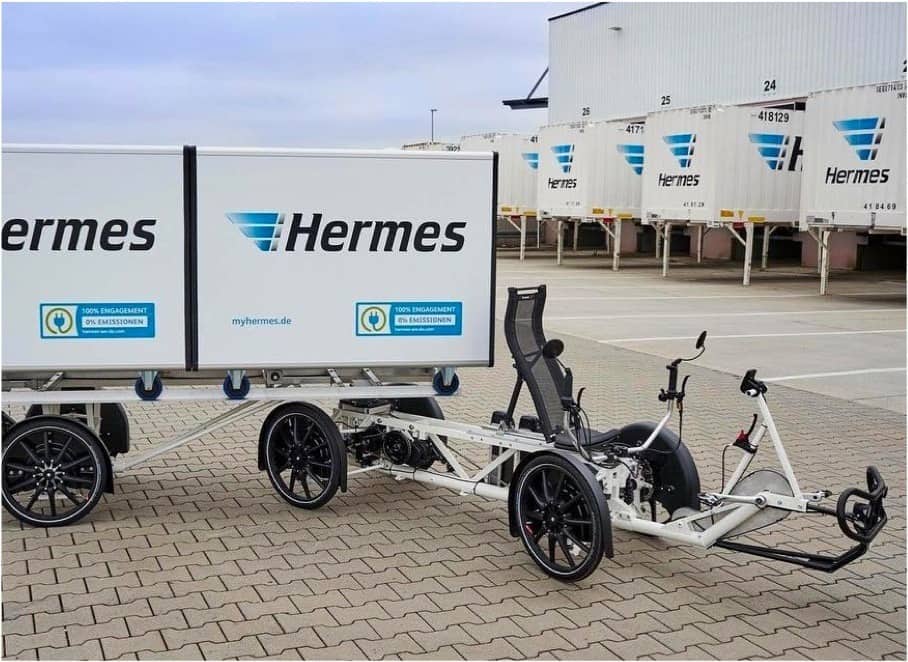
Real-life case studies show that there is a clear business case for cycle logistics. In recent years the likes of Fedex, DHL, UPS, Amazon, DB Schenker, DPD, GLS and Hermes have all added cargo bikes to their fleets, and across the world cargo bikes are used by organisations of all shapes and sizes. Let’s rewind and explore some of the reasons why.
They’re quicker
Time and time again it has been shown that cargo bikes can get the job done quicker in cities. Data from a cycle logistics hub set up in car-addicted Sydney in 2016 showed that cargo bikes travelled a third few kilometres than vans, taking less than half the time to complete their rounds in the CBD. But how?





Bikes are nimbler, can use cycle lanes, take shortcuts and park with ease. Meanwhile, vans spent three times as long parked up compared to bikes. And whilst bike couriers hardly needed to walk at all – having parked just outside the door, van drivers walked approximately a third of their total distance. In Sydney it’s evidently easier to just park and walk than to constantly drive around looking for parking spaces.
“…routing is key, with cargo bikes able to take much shorter routes than e-vans.
They’re energy efficient
A study by Velove and the Swedish Energy Agency showed that e-cargo bikes consume 94% less energy than traditional e-van for the same deliveries. Yes you read that right: 94% less. Weight is the obvious factor here; the e-van tested, a Nissan e-NV200, weighed approximately 17 times as much as the e-cargo bike. And like in Sydney, routing is also key, with cargo bikes able to take much shorter routes than e-vans.
Their footprint is small
Readers will be no strangers to the environmental benefits of ultra-low-emission forms of mobility such as the cargo bike. Not mentioned in the Swedish study were embodied emissions from manufacture; far lower for e-cargo bikes than for e-vans due to the amount of materials consumed.
“In terms of both costs and environmental impact then, the cargo bike has a distinct edge

In both cases, cargo bikes do have an environmental impact. However, the lower weights and speeds involved mean that their footprint is orders of magnitude slimmer.
It’s the Decade of the Cargo Bike
In terms of both costs and environmental impact then, the cargo bike has a distinct edge – but that’s not all. Depending on where you’re based, cargo bike sales are now often supported by subsidies from local, regional or national government. Cities worldwide are realising that alongside cycling for personal mobility, cycle logistics is intensely compatible with their efforts to foster liveable urban environments. If you close your city centre to internal combustion engine vehicles, the cargo bike is an important ally to keep urban logistics flows going.

“The cargo bike’s star is rising, but the benefits don’t come without costs
This article originally appeared on Urban Mobility Daily.

Check out Features: longer reads and deep dives into the world of cargo bikes and pedal powered logistics, from the International Cargo Bike Festival…
-
Gallery: ICBF 2025 Recap
On Monday 13th and Tuesday 14th October 2025, professionals from the cargo bike industry gathered in Utrecht for the 2025 edition of the International Cargo Bike Festival. Here are some of the highlights.
-
Opinion: Overcrowded bike lanes? Why not ride on the road?
The Netherlands increasingly crowded bike lanes are seeing increasing speed, size and mass of bicycles - and the safety of the most vulnerable cyclists sometime suffers because of it. But, as Jos Sluijsmans argues, a solution could lie in the law as it now stands.
-
Enter the 3X3 NINE: Heavy Duty for Heavy Hauling
Lindsay Broadwell takes a deep-dive into 3X3's NINE hub. "For me, it’s one of the most exciting innovations that I’ve come across in quite a long time."
-
Where do we go from here? A cargo bike research call to action
Cycling, and particularly cargo cycling, has only recently started to attract much in the way of academic attention. While cycling as a whole is pretty commonly discussed in academic circles, especially around sustainability and getting rid of the dominance of the car in our lives, our towns, and our cities (and rurally too!) – the cargo bicycle specifically is a bit neglected.
-
Wheels of Resilience: CargoCult’s Unexpected Journey
Yuliya Belinskaya is one of the three founders of CargoCult in Kyiv, Ukraine. Back in 2021, amid the pandemic, she started the cargo bike delivery company alongside co-founders Karina Agakhanova and Oleksii Khvorostenko. But as Yuliya explains, although CargoCult have designed, built and used their own cargo bikes a lot since then, things didn’t quite work out exactly how they had expected.
-
Cargo bikes: are our imaginations holding us back?
What is cycling? What can you do with a bicycle? Empirically, a huge amount, but depending on who you ask, it often isn’t seen that way.
-
Gallery: ICBF Parade 2023
On Sunday 26th November 2023, a group of cargo bikers braved the cold, wet weather for a parade through Amsterdam, organised by Bike Sound System and Dr. Beyk. The parade stopped briefly at Dam Square and Museumplein before ending at the International Cargo Bike Festival venue RAI Amsterdam. Here are some of the highlights.
-
Opinion: Jos Sluijsmans on the ICBF's partnership with Fully Charged LIVE
“Why are you working with a car show?” It’s a loaded question – one we have been asked a lot by our friends in the cargo bike world since we announced our partnership to ‘co-locate’ the International Cargo Bike Festival alongside Fully Charged LIVE Europe. So, why?
-
BYCS Perspectives: Editorial - The cargo bike is already serving as a change-maker
ICBF Co-organiser Tom Parr explores the topic of resilience and cargo bikes. The final instalment of the Perspectives: First & Last Mile series of articles - in partnership with BYCS.
-
BYCS Perspectives: Powering New African Mobility, with Valerie Labi
Valerie Labi, CEO of Wahu!, explains how cargo bikes can bridge Ghana's "connectivity gap". Part of the Perspectives: First & Last Mile series in partnership with BYCS.
-
Thinking outside the box
Jurjen Vellinga, Product Development Lead at DOCKR, has seen through several high-impact design projects in his short time at the company. We sat down with him to discuss some of the innovations he’s most proud of, and find out what they mean for DOCKR’s customers and the wider cargo bike industry.
-
2023 according to DOCKR:
Kees Jan Blankestijn, Co-founder and Head of Product and Innovation at DOCKR on the five trends that will shape the future of mobility
-
We need to talk about diversity in the cargo bike industry
The cargo bike is a machine that can act as a social leveller. But is that enough? MJ Somerville and Tom Parr reflect on diversity in the cargo bike industry and explore what needs to change.
-
Five questions for… Yuliya Belinskaya of CargoCult Kyiv
One of the co-founders of Kyiv-based CargoCult, Yuliya Belinskaya, tells us about how they launched the first cargo bike business in the Ukrainian capital, the effects of the Russian invasion and their hopes for the future.
-
Dodging the issue the cargo bike’s real impacts
Natalia Barbour reflects on the social and environmental impacts of the cargo bike.
-
The CooP-Bike: a cargo bike for Africa
CooP-Africa builds and modifies various types of bicycles, serving rural and peri-urban communities in Kenya and Uganda. CooP-Africa's Luuk Eickmans introduces us to a variety of these life-changing bikes and cargo bikes, and how they are used.
-
Driving Change
Scale-up New Motion Labs is preparing for the future by making changes at the top. We sat down with Marcel Fowler and Steven Senior to find out more about these changes, what drives them and what this means for the company, their customers, and the wider industry.
-
We need to talk about TCO
As the cargo bike is adopted by more and more organisations across commercial, governmental and voluntary sectors, the demand for a coherent story and vision about the Total Cost of Ownership is becoming increasingly necessary.
-
Behind the scenes: DOCKR’s expansion into Germany and Belgium
We take a look behind the scenes at DOCKR, focusing on their move into Belgium through the eyes of Expansion Managers Nina van Spengen and Shahram Razasade.
-
Anatomy of a cargo bike breakdown
Tom de Wilton of Oxwash on the impact a cargo bike breakdown can have on an organisation, and Marcel Fowler and Lucas Lobmeyer of New Motion Labs on how breakdowns can be prevented.
-
Cargo bike by subscription – the story of Oslo startup Whee!
Kari Anne Solfjeld Eid is a Norwegian cargo bike lover, bike activist and entrepreneur based in Oslo. She runs design agency Hoi! Oslo and last year launched Whee!, an e-cargo bike subscription service. This year they’ve extended their offerings with a maintenance subscription service and opened Kiosk, a community-owned coffee shop. This – in her own words – is the story of how they did it.
-
The connected cargo bike
Cycle logistics is a complex business. But as the number of cargo bikes in commercial fleets explodes, how can organisations keep up? Two companies have decided that close cooperation between them is the key. We sat down with Luuk Nijland of Cargo Cycling and Andrej Sobotkiewicz of Paztir to find out how data can streamline cycle logistics for the benefit of riders, fleet managers and clients alike.
-
Interview with Paztir CEO Andrej Sobotkiewicz
As Andrej Sobotkiewicz, Founder and CEO of Paztir, prepares to steer the business into 2021, he talks about the scale-up’s origin story, the challenges of 2020 and how he sees the future of last-mile logistics.
-
Cargo Cycling and Swobbee: collaborate to innovate
When two of the most innovative businesses in cycle logistics join forces to collaborate, it draws attention from across the industry. Although Cargo Cycling only launched in April 2020, the brand boasts a fully-formed range of cargo bikes, including models for seemingly every possible use case. Meanwhile, Berlin-based Swobbee are blazing an innovation trail with their smart batteries and charging infrastructure. Could this be a marriage made in heaven for Fleet Managers?
-
The Business Case for Cargo Bikes
As traffic volumes increase in our city centres, partly fuelled by deliveries from a COVID boosted e-commerce sector, organisations are looking for a silver bullet for urban logistics. But has it been sitting right here under our noses all this time?